Published after Jane Street posted the official solution. If you still want to solve “Hint Singles” yourself, stop here.
Every month Jane Street publishes a puzzle and a list of everyone who sent in the right answer. On September 4th, 2026 I pointed a Claude Code session at the September puzzle from my phone and let it run, with Gemini doing the reading. This post is the log of what happened, with real timestamps pulled from the session transcript, because “we solved it in 20 minutes” is the kind of claim that deserves receipts.
The puzzle
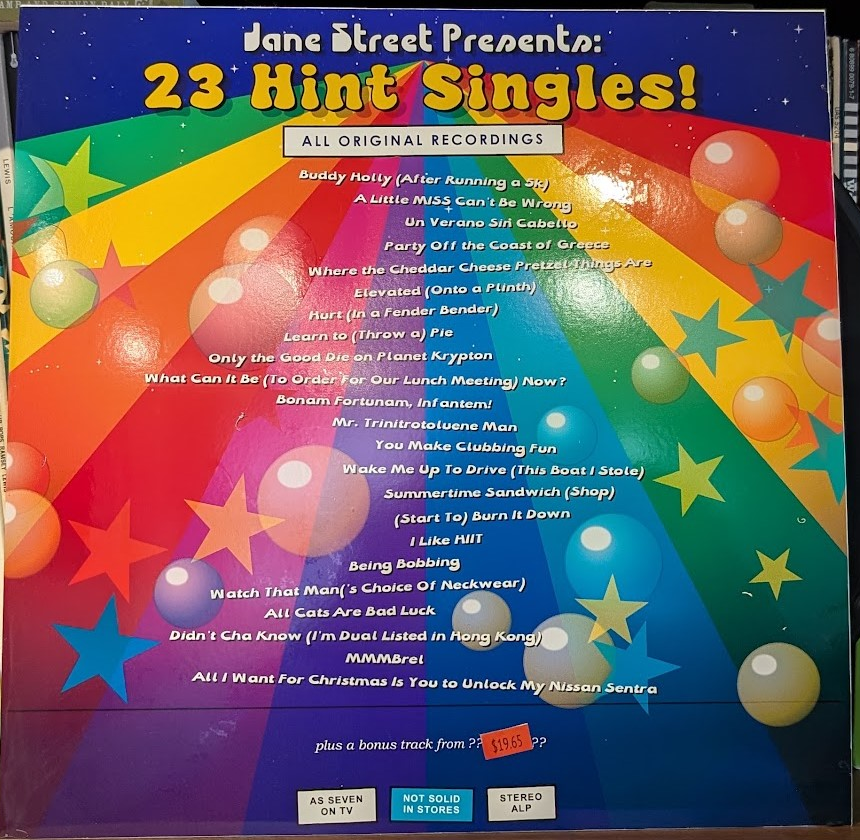
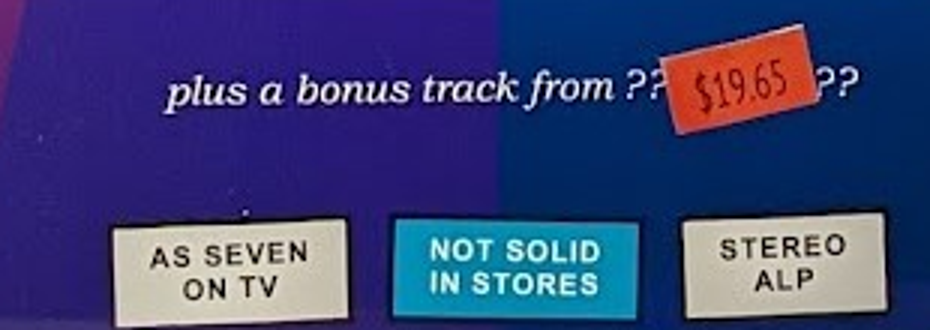
The whole puzzle is one photo: a record sleeve on a shelf, titled Jane Street Presents: 23 Hint Singles!, with 23 track titles, a bonus track hidden behind a $19.65 price sticker, and three badges along the bottom. The only text on the page reads: “The answer to this month’s puzzle is a brand you’ve probably never heard before…”
No grid, no numbers, no rules. Just a picture.
Setup
- Claude Code (Claude Fable 5.1) running on a small VM, driven from my phone through a terminal-in-the-browser tool I built for exactly this kind of remote steering.
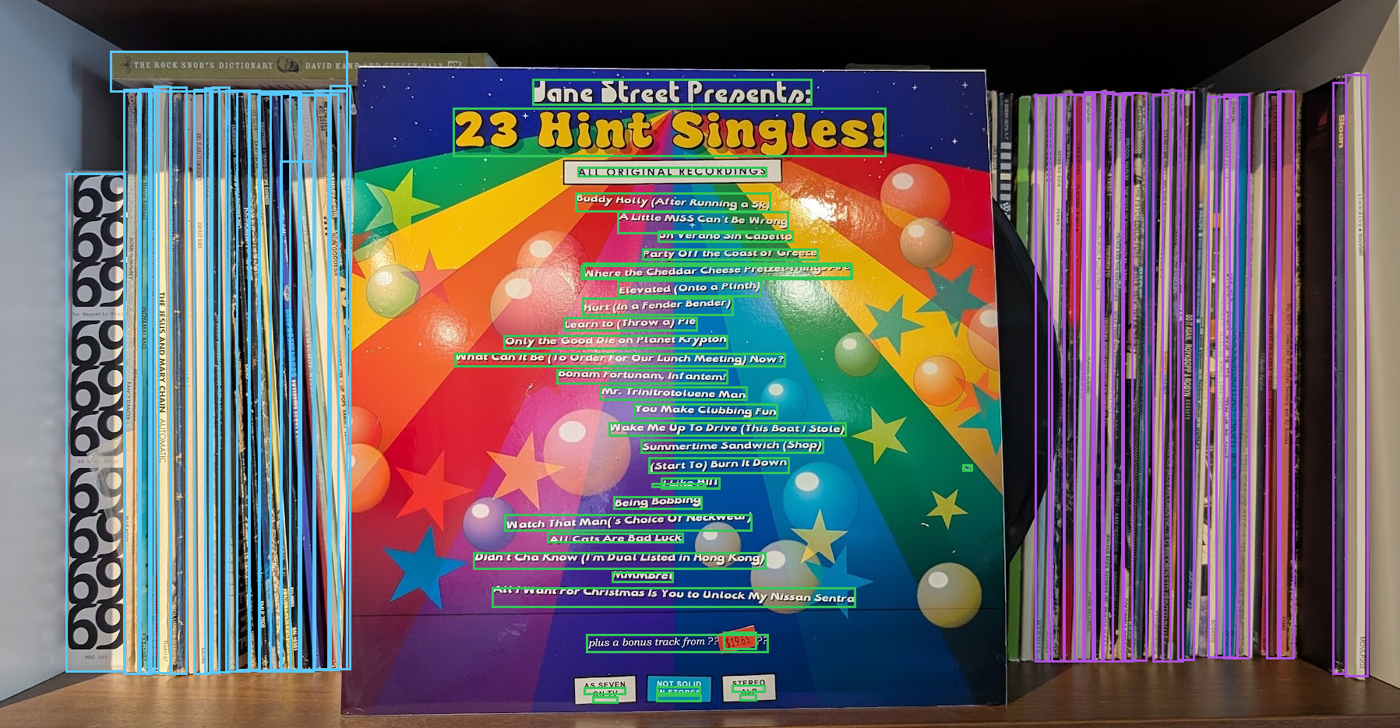
- Gemini 3.8 Flash via OpenRouter for OCR. Not plain transcription: every text element came back with a bounding box in Google’s
[ymin, xmin, ymax, xmax]convention on a 0 to 1000 grid, so the boxes could be drawn back onto the photo and checked by eye. - A budget of about one dollar. The whole thing ended up costing 45 cents.
Timeline
Timestamps are UTC, taken from the session file.
| Clock | Elapsed | What happened |
|---|---|---|
| 15:44 | 0 min | First message: “check this, let’s start with OCR and bounding boxes” |
| 15:51 | 7 min | OpenRouter key handed over through a paste modal on the phone, first OCR runs |
| 15:59 | 15 min | Account had no credits. Bought some, told Claude to stay on Flash |
| 16:03 | 19 min | “Solve this puzzle” |
| 16:29 | 45 min | Answer candidate on the table, 20 of 23 tracks solved, interactive board on my phone |
| 16:52 | 68 min | All 23 tracks confirmed |
| 17:07 | 83 min | Submitted |
| 18:09 | 145 min | Name on the solver list |
So: 26 minutes from “go” to the answer, 49 minutes from “go” to a fully verified solution. The first 19 minutes were spent on a missing API key and an empty balance, which is the least glamorous part of any agent workflow and also the most typical.
How it fell
Claude read the image itself before the OCR results were even back, and the first three tracks gave the mechanism away:
- Buddy Holly (After Running a 5k): that is a Weezer song, and after a 5k you are a Wheezer.
- Un Verano Sin Cabello: Bad Bunny’s album, without hair, so Bald Bunny.
- Hurt (In a Fender Bender): Johnny Cash, in a crash, so Johnny Crash.
Every track is a real song, retitled so that the new title describes the artist’s name with exactly one letter inserted. The sleeve itself demonstrates the trick before you even reach the tracklist: Hint Singles instead of Hit Singles, As Seven On TV, Not Solid In Stores, Stereo ALP. Even the puzzle description does it: a brand is a band plus an R.
Twenty tracks fell in one pass. Mariah Carey became Mariah Car Key (unlock my Nissan Sentra), Erykah Badu became Erykah Baidu (dual listed in Hong Kong), Hanson became Chanson (MMMBrel), Pet Shop Boys became Pet Shop Buoys (being bobbing), Linkin Park became Linkin Spark (start to burn it down).
Then the inserted letters, read in track order, spelled a sentence with three gaps:
H E L P · O U R · D R U M M E R · I S · O U T · S I C K
Help! Our drummer is out sick. The price sticker reads $19.65, and Help! came out in 1965. The hidden bonus track is by The Beatles, and a band whose drummer is out has no beat.
The answer is The Beatless. A brand you have never heard before, in both senses.
The three hard tracks
Reading the message backwards was the trick that closed the puzzle. Once 20 letters were in place, the three missing ones were forced: track 2 had to be an E, track 6 a U, track 14 an R. That turns an open search into a closed one.
Claude got stuck on these three for a while by looking for famous songs. The fix was to search from the target word backwards, and to hand each open item to Gemini Flash as a separate brainstorm prompt with the letter constraint spelled out.
- Track 2, “A Little MISS Can’t Be Wrong”: Spin Doctors plus E is Spine Doctors. The capital letters are a real medical acronym, MISS stands for Minimally Invasive Spine Surgery. Flash produced that one.
- Track 6, “Elevated (Onto a Plinth)”: what gets elevated onto a plinth is a statue. State Champs plus U is Statue Champs, and “Elevated” is a real State Champs song from 2013. Flash again.
- Track 14, “Wake Me Up To Drive (This Boat I Stole)”: enumerate boat words that lose an R and become a band name. A brig is a ship. Big Thief plus R is Brig Thief, and “Wake Me Up to Drive” is a real Big Thief song from 2022. That one came from the backwards enumeration.
Both songs were verified with a web search before anything was submitted.
What worked and what did not
Worked
- Bounding-box OCR. Every box landed on its text, including the vertical record spines read from rotated crops. It made verification a visual check instead of a trust exercise.
- Constraining before brainstorming. Twenty confirmed letters made the remaining three a lookup, not a search.
- A second model with a different prior. Flash knew State Champs and the MISS acronym. Claude did not, and had burned real time enumerating the wrong space.
- The whole loop running on a phone. I never opened a laptop.
Did not
- The first 19 minutes. Key hunting, a 402 from OpenRouter’s pre-flight cost check, model selection. Tooling, not thinking.
- Reasoning budgets. The first Flash brainstorm runs used “high” effort with a 16k token cap and got truncated by their own thinking. Medium effort with a 30k cap fixed it.
Who did what
Honestly: Claude did the solving. I chose the puzzle, set the direction (OCR with boxes, Gemini, stay on Flash), bought the credits, kept the pace up, asked the one question that tested the answer (“but it says brand?”), and pressed submit. Somewhere between 10 and 25 percent depending on how you count, and the interesting part was watching where a strong model gets stuck and what un-sticks it.
The tooling is now a pipeline. When the October puzzle appears, a timer spawns a fresh session that fetches the page, runs the OCR, builds the board, and then stops and asks how far it should go. This time I want to be the one solving.
Total cost: 45 cents in API calls. Session: 83 minutes from first message to submission.